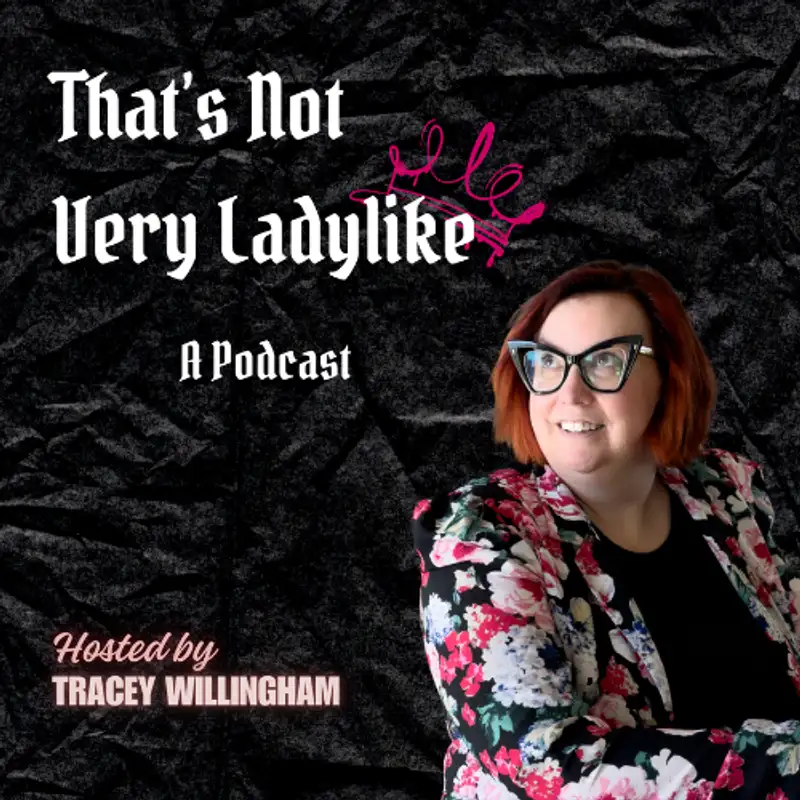
You're listening to That's Not Very Ladylike, the show where every week we start with one rule, ladies don't, and then we do it anyway. You're listening to That's Not Very Ladylike, the show where every week we start with one rule, ladies don't, and then we do it anyway. Welcome back. I'm That Hormone Girl, Tracy Willingham. And today's rule is one you probably performed in an email before lunch today.
Tracey:Ladies don't have a tone. They just say it nicer until it disappears. So you type the sentence, the true one, the one you really want to say, the clear one. And then you read it back and something goes, Oh, that's a little much. So you add a just to it.
Tracey:You add an exclamation point so nobody thinks you're mad. You put, I could be wrong, but on the front of your sentence. You put, Does that make sense? On the end of the sentence. And what leaves your outbox is four sentences of a completely untrue, not direct, and probably even confusing email with a request that no longer even exists.
Tracey:Right? And then the thing doesn't get done. And then we're like, isn't anybody listening to me? Because you took what should have been direct communication and turned it into something where everybody's like, Okay, Tracy got it. Check.
Tracey:Done. So today we're talking about what happens to a woman who spends thirty years translating herself into something easier to swallow for others. So it's story time, you know what to do. Pull up your chair, get your comfy blanket, kick off your shoes. So I had a boss once who told me that I lacked a filter.
Tracey:And listen, that hit me. Okay, it still kind of hits me. I'm not going to lie. It triggers me. I took it all in.
Tracey:And I didn't question it, right? Because I mean, this boss at the time seemed very caring, very concerned for me as a person. So I didn't ask for an example. I didn't push back. I just accepted it as like, you've been around longer than me.
Tracey:You're a mentor. You have to know. You've seen this in the field. So for years afterward, I generally believed I had to watch my words because I was a rude person. I thought I was crude even.
Tracey:And I even started to question, am I a person who barrels through conversations without considering how anybody else would feel? And so I carried that. And I want you to understand, like, I carried it around so much that I made adjustments to myself to ensure that other people remained comfortable. So I was quieter in the rooms. I second guessed everything I said before I said it.
Tracey:I ran myself through a ridiculous filter where I build out one sentence 20 times. And it wasn't until after I left that job, and honestly, even as I've gotten older, that I've been able here even recently to look back at that with clear eyes and go, Hold on a minute. I was never rude. What I was, was I was comfortable saying what I was feeling or thinking in the moment. I was comfortable asking tough questions.
Tracey:I was the person in the meeting who pushed to make sure everybody in the room got heard and felt seen. That is what I was actually doing. And here's what I finally understood. Not having a filter or having a tone is not about being rude. It is about somebody else's discomfort with what you say as your truth, your passion, or even your personality.
Tracey:And that's it. That's the whole trick. Their discomfort got written up as my character flaw. And I accepted it for years. So let's look at the cost because there's three of them and they actually stack on each other.
Tracey:So obviously the first cost, it's going to be an obvious one. The message does not land. So you say it so gently that the actual information just falls out from it. And then you get a second penalty on top because now you look indecisive or like you don't know what you want. So you kind of hedged it.
Tracey:So you get read as unsure. And then somebody louder and allowed to speak the way they want makes the same call and gets credit for being decisive. The second cost is energy. Running every sentence through a filter before it leaves your mouth is a second job. It runs all day.
Tracey:So it's going to run-in your meetings. It runs in your text messages. It runs at the table at Thanksgiving. You spend your time drafting and redrafting in real time while also doing your actual work. And then you wonder why you're wiped out by two in the afternoon.
Tracey:And the third cost is the worst one. And it's what happened to me. You accept a verdict about your character based entirely on someone else's comfort level. And it doesn't stop there. You then rebuild yourself around it.
Tracey:Years of it. I lost years. I lost years to a sentence because a boss said something to me inside my work environment. And then let's just light touch on the hormone piece. And perimenopause, the patience for all that softening, if it hasn't ran out, it's about to.
Tracey:You just do not have the bandwidth for this nonsense anymore. And the true sentence, it becomes plain. And that's the exact moment a woman gets told, Woah, this is not you. What is going on with you? You are hormonal.
Tracey:So you get it coming and going, right? Soften it and you're not taking it taken seriously. Say it plainly and you're not yourself. So then there's no version where you win by adjusting it. So let's go back into history because this one is old.
Tracey:And I want to start with the sentence itself. Watch your tone. Where do you hear that? You hear it said to a child. It's a discipline sentence.
Tracey:Watch your tone. It's a sentence spoken by someone with authority to someone without it. So this has been documented and studied for decades. Women are socialized to use hedges and softeners. And what those sound like would be words like I think, just, would you mind, sorry to bother you.
Tracey:Does that make sense? And the reason given over and over in research is that women are expected to be the keepers of social harmony. Our job in language is to literally prevent conflict, not to state positions. So we mitigate, we soften. We ask for permission to say the thing we already really want to say.
Tracey:There is no evidence that you can bring. There is no recording that settles it. You cannot prove you did not have a tone. Because here's what I want you to hear today. You had a tone is not actually describing your voice.
Tracey:It's describing how somebody felt while you were talking and when you delivered it to them. So who does that serve, right? It's not complicated, right? I feel like it's the same. Like when we get to this section, you guys like, I know, I know.
Tracey:But I mean, that's when you start digging in and looking at it, it is ridiculous how much is put on women and how much of it is catering to society's wishes. So if the delivery is always available for debate, the content never has to be addressed. So nobody has to answer the question you asked. They just have to comment on how you asked it. You like that avoidance right there?
Tracey:Let's say it again. They don't have to answer your question. If they can tell you, Watch your tone, or You have an attitude, you had tone with that, now I don't have to answer that question. Have to do this is my podcast, and I'm going to do this every single time because we have to acknowledge that this rule does not fall evenly. Black women get tone policed faster, harder, and with much heavier consequences.
Tracey:The research on Black women in professional settings documents a moving target. Watch the tone. Watch the volume. Watch that face. And if toe that line, you get labeled as angry, loud, or boisterous.
Tracey:Some of those women describe self policing in advance all day just to preempt it. So when we talk about tone, we have to be honest that some women are handed this rule with a shorter fuse and a bigger penalty attached. And we always will hold the full sisterhood in these conversations. So, if this could be said, it would sound like this: I am allowed to say the sentence once plainly. I am allowed to ask the hard question.
Tracey:I am not responsible for managing your reaction to information. Direct is not rude. My personality is not a performance issue. And I am allowed to stop translating myself for people who understood me perfectly well the first time I said it. So this should piss you off.
Tracey:This should piss you off because you were handed feedback that cannot be proven. It can't even be disproven. And so there's nothing to fix. And then you are still held responsible for it indefinitely. This is pissing me off, right?
Tracey:Most of us did what I did. We went home and quietly rebuilt our whole personality around one person's discomfort. And we looked at them and said, Thank you so much for being interested in my growth as a human being. But here's what pisses me off now as I have done the work and reflected the traits that got corrected out of us are the traits that good organizations pay for. Saying the true thing, asking the question everybody in the room was avoiding, making sure the quiet person was heard.
Tracey:That is leadership. That is what they put on a job posting. But that really, let's be truthful, was meant for men. It's not supposed to be on the female job posting. So we're not being coached on a weakness.
Tracey:We're being written up for leadership by somebody who found it inappropriate or inconvenient. So how do you know if this is you? This might be you if you rewrite an email more than twice. You add exclamation points so you don't seem cold. You open with Sorry to bother you or Quick question.
Tracey:You've said the same thing three ways in a meeting, and then it finally landed when a man said it once. Somebody once told you that you're a lot, and you built your whole adult self around not being a lot. You practice the sentence in the car before you go in. You have apologized for the tone of something you had every right to say. So if that's you, let me be the first in case you've never heard it to say you are not a difficult person.
Tracey:You are actually fluent in a second language that you were forced to learn that you did not sign off on or agree to learn. So this week, here's how I want you to take care of yourself. I want you to send one message with the softener stripped out. Just one. So take out the just, take out the exclamation point.
Tracey:Don't open it with I could be wrong, but just say the thing in one clean sentence and hit send before you can just redo the whole text. And then watch what happens. The house does not burn down. The world does not stop spinning. Crazy.
Tracey:The world does not implode. Usually what happens is that thing just gets done. And if somebody does tell you that you have a tone, here's your follow-up question because I'm not going leave you hanging because somebody's still going to say you've got the 'tude, right? You get attitude. And you can say it perfectly pleasantly if you want to.
Tracey:So they say you have a tone, what I want you to respond with, I hope some of you do this, email me if you do it. You ask them, What specifically did I say that you disagree with? You need to watch your tone. You have an attitude. Okay, what specifically did I say that you disagree with?
Tracey:That single question moves the conversation off of your delivery and back onto the content, which is exactly where it belonged the whole time. Because here's what we know now, guys, right? Direct is not rude. Atone is not a fact. It is a feeling somebody had and handed back to you.
Tracey:You are allowed to say it once, clearly, and let it stand there. Softening it until it disappears, it does not make you kind. All it makes you is unheard. And a woman who says the thing plainly, the woman who stops translating herself into something easier to swallow, the woman who lets other people be a little uncomfortable with her truth, That's the most unladylike thing of all. Thanks for joining me today for That's Not Very Ladylike.
Tracey:If today's episode lit a fire, pushed your buttons, or called a little BS on the stories we've been sold, share it with another woman who's tired of being told to tone it down, smile more, or play nice. And help a girl out by making sure you subscribe, leave a quick review, and catch me on Instagram at that hormone girl. And until next time, keep getting loud, messy, and raising hell because being ladylike is overrated.